Oasis Chevron Knit Slipper Sock Free Pattern: Desert Boho Fair Isle Tube Slippers

Oasis Chevron Knit Slipper Sock: A Desert Boho Fair Isle Tube Slipper
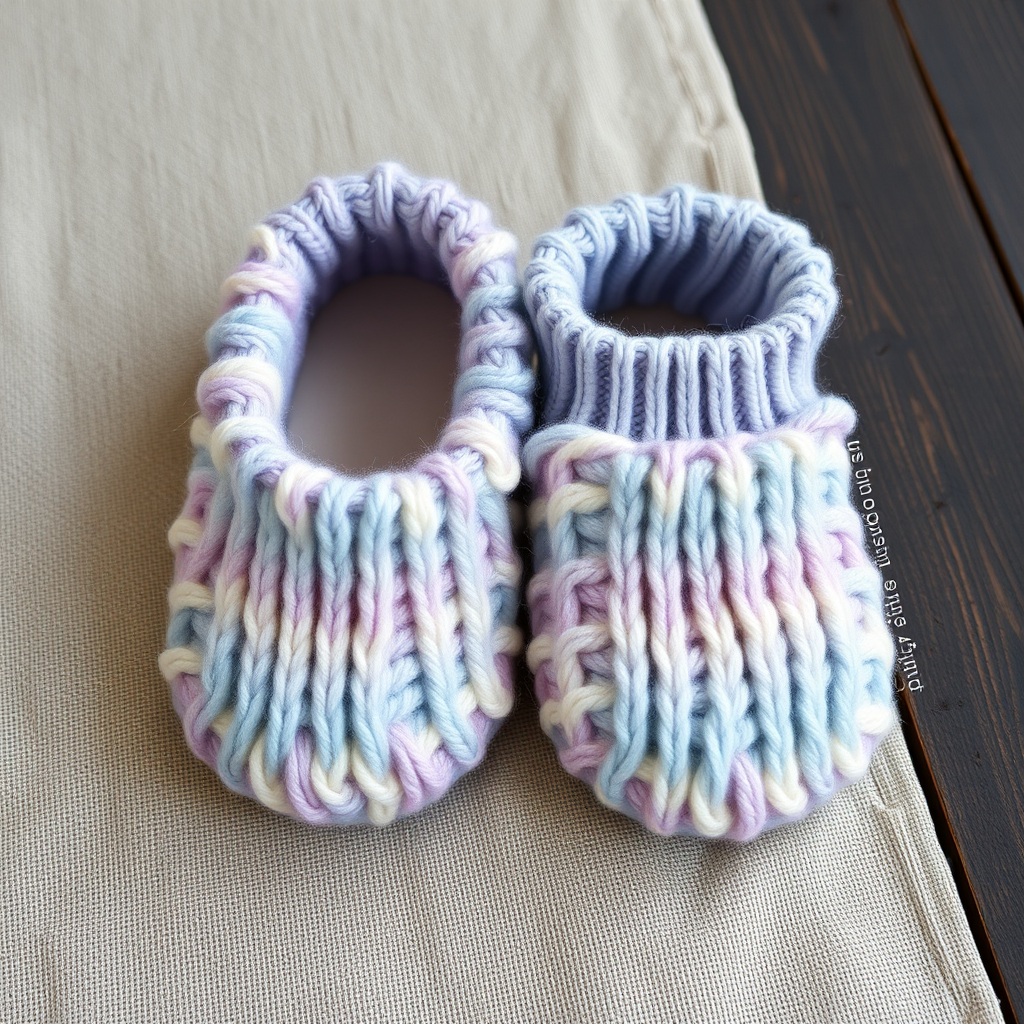
If you have ever wanted to try colorwork but felt intimidated by tiny sock needles and complicated heel turns, this is the project for you. These slipper socks are worked as a simple straight tube from toe to opening — no heel shaping, no picking up stitches, no fuss. The alternating denim blue and cream chevron bands give them a relaxed desert boho feel, and the bamboo cotton yarn makes them soft, breathable, and gentle on bare feet. The finished slipper is a slightly slouchy, seamless tube with a smooth grafted toe and a cozy ribbed cuff that hugs your ankle. Perfect for beginners ready to stretch their skills just a little, and for anyone who loves a cozy, handmade touch around the house.
Materials Needed
- Yarn: Worsted weight bamboo cotton yarn (approximately 60% bamboo, 40% cotton; 180 yd / 165 m per 100 g skein). MC (main color): denim blue, 1 skein (approx. 90 yd / 82 m). CC (contrast color): cream, 1 skein (approx. 70 yd / 64 m). Sample uses approximately 80 yd MC and 60 yd CC for a women's medium pair.
- Needles: US 5 (3.75 mm) double-pointed needles (set of 4) or a 32 in / 80 cm circular needle for magic loop, or size needed to obtain gauge.
- Tapestry needle for grafting the toe and weaving in ends.
- Stitch marker to mark the beginning of the round.
- Scissors for cutting yarn.
- Optional: non-slip fabric (shelf liner or suede patches) and fabric glue for a safety sole.
- Finished size: Women's Medium (fits US shoe size 7–9, foot length approx. 9.5 in / 24 cm). Finished slipper: 8.5 in / 21.5 cm circumference (unstretched), 9.5 in / 24 cm foot length from toe to heel, 3.5 in / 9 cm leg opening height.
Abbreviations and Beginner Glossary
- k – knit: insert the right needle into the front of the stitch from left to right, wrap the yarn around, and pull a loop through.
- p – purl: insert the right needle into the front of the stitch from right to left, wrap the yarn around the front, and pull a loop through.
- k2tog – knit 2 stitches together: insert the needle into the next two stitches at once and knit them as one. This decreases your stitch count by one and leans to the right.
- kfb – knit into front and back: knit into the front of the stitch as normal, then knit into the back of the same stitch before slipping it off. This increases your stitch count by one.
- MC – main color (denim blue).
- CC – contrast color (cream).
- sts – stitches.
- round – one complete circuit of knitting around the tube.
- stockinette stitch – in the round, this means knitting every stitch on every round (smooth on the outside).
- ribbing (k1, p1) – alternating one knit and one purl stitch around; it creates a stretchy, textured band.
- provisional cast-on – a temporary cast-on (often a crochet chain) that can be undone later to expose live stitches.
- Kitchener stitch (grafting) – a way of joining two sets of live stitches so the seam is invisible and smooth.
- bind off – finishing the edge so stitches don't unravel; work each stitch and pass the previous one over it.
- blocking – gently wetting and shaping the finished piece so it dries to the correct measurements.
Gauge
22 sts and 28 rounds = 4 in / 10 cm in stockinette stitch worked in the round, blocked. The chevron colorwork pattern measures approximately 4.5 in / 11.5 cm wide across 48 sts and 3 in / 7.5 cm tall across 24 rounds.
Why gauge matters: Gauge is how many stitches and rounds fit into one inch of knitting. If your gauge is off, your slipper will be too big or too small. How to swatch: Cast on about 30 stitches with MC, work in stockinette (knit every round) for about 4 inches, bind off, and block. Lay a ruler across the middle and count how many stitches fit in 4 inches. If you have more than 22, your knitting is tight — try a larger needle. If you have fewer, try a smaller needle. Always swatch before you begin!
Beginner Tips Before You Start
- Use a stitch marker at the beginning of every round so you always know where you are — especially important when the color changes.
- Do not pull your yarn too tight when changing colors. Carry the unused color loosely along the inside so the tube stays stretchy.
- Count your stitches at the end of every chevron round. You should always have 48 stitches — the k2tog decreases and kfb increases balance each other out.
- Try the slipper on as you go. Because it is a simple tube, you can slip it on to check the fit before you finish the cuff.
- Keep your floats (the carried yarn) relaxed. If you can stretch the fabric comfortably, your floats are the right length.
- Work the second slipper exactly the same way so the pair matches in size and pattern placement.
Step-by-Step Instructions
Toe (worked in the round from a provisional cast-on)
With MC, using a provisional cast-on (crochet chain method), cast on 24 sts. Divide evenly across 3 double-pointed needles (8 sts per needle) or arrange for magic loop. Join to work in the round, being careful not to twist. Place marker at beginning of round.
Round 1: Knit all stitches. (24 sts)
Round 2 (increase): *K1, kfb, knit to last 2 sts of needle, kfb, k1; repeat from * on each needle. (32 sts)
Round 3: Knit all stitches. (32 sts)
Round 4 (increase): *K1, kfb, knit to last 2 sts of needle, kfb, k1; repeat from * on each needle. (40 sts)
Round 5: Knit all stitches. (40 sts)
Round 6 (increase): *K1, kfb, knit to last 2 sts of needle, kfb, k1; repeat from * on each needle. (48 sts)
Round 7: Knit all stitches. (48 sts)
Remove the provisional cast-on and place the 24 cast-on stitches on a spare needle or waste yarn. Graft the toe opening closed using Kitchener stitch with MC. (Alternatively, leave the provisional cast-on in place and graft at the very end.) The toe measures approximately 1.5 in / 4 cm from graft to increase rounds.
Foot and Leg (worked in the round over 48 sts)
Chevron pattern (worked over 12 sts and 12 rounds):
Rounds 1–2: With MC, knit all stitches.
Round 3: With CC, *k1, k2tog, k3, kfb, k1, kfb, k3, k2tog, k1; repeat from * to end. (48 sts)
Round 4: With CC, knit all stitches. (48 sts)
Rounds 5–6: With MC, knit all stitches. (48 sts)
Round 7: With CC, *k1, k2tog, k3, kfb, k1, kfb, k3, k2tog, k1; repeat from * to end. (48 sts)
Round 8: With CC, knit all stitches. (48 sts)
Rounds 9–10: With MC, knit all stitches. (48 sts)
Round 11: With CC, *k1, k2tog, k3, kfb, k1, kfb, k3, k2tog, k1; repeat from * to end. (48 sts)
Round 12: With CC, knit all stitches. (48 sts)
Repeat Rounds 1–12 four more times (60 rounds total of chevron pattern).
Rounds 61–62: With MC, knit all stitches. (48 sts)
Round 63: With CC, *k1, k2tog, k3, kfb, k1, kfb, k3, k2tog, k1; repeat from * to end. (48 sts)
Round 64: With CC, knit all stitches. (48 sts)
Rounds 65–66: With MC, knit all stitches. (48 sts)
Round 67: With CC, *k1, k2tog, k3, kfb, k1, kfb, k3, k2tog, k1; repeat from * to end. (48 sts)
Round 68: With CC, knit all stitches. (48 sts)
Round 69: With MC, knit all stitches. (48 sts)
Rib Opening
Rounds 70–77: With MC, work in k1, p1 ribbing (knit 1, purl 1) around for 8 rounds. (48 sts) The opening measures approximately 1.5 in / 4 cm in ribbing.
Bind off all stitches loosely in rib pattern using MC.
Assembly and Finishing
Grafting the toe: If you left the provisional cast-on in place, undo it now and place the 24 live stitches on two needles (12 and 12). Thread a tapestry needle with MC and work Kitchener stitch: bring the needle through the first stitch on the front needle as if to purl and leave it on; through the first stitch on the back needle as if to knit and leave it on; then repeat the pattern of slipping stitches off after working them, keeping the tension even. This creates a smooth, invisible seam.
Weaving in ends: Turn the slipper inside out and thread each yarn tail onto the tapestry needle. Weave it in and out of several stitches on the wrong side, then change direction and weave back through a few more stitches to lock it in place. Trim the end close to the fabric — do not pull tightly or the fabric will pucker.
Blocking: Lightly mist the finished slipper with water and lay it flat, shaping it to the measurements given (8.5 in circumference, 9.5 in length). Let it dry completely. The bamboo cotton will soften with wear.
Optional non-slip sole: Cut a piece of non-slip fabric to fit the sole of the slipper. Attach with fabric glue or hand-sew in place using matching thread. This is recommended for safety on smooth floors.
Make a second slipper identical to the first.
Pro Tips and Variations
- Color changes: Swap the denim blue and cream for any two colors you love — try terracotta and sand for a warmer desert palette, or sage and ivory for a softer look. Keep one color light and one dark so the chevron pattern stands out.
- Size adjustments: To make a larger or smaller slipper, add or remove one 12-stitch chevron repeat (12 sts = about 2 inches of circumference). Adjust the toe increases accordingly so you end with a multiple of 12 stitches.
- Yarn substitution: Any worsted weight yarn will work — wool blends will be warmer, while cotton blends stay breathable. Always swatch to confirm gauge before you begin.
- Add a folded cuff: For extra coziness, work the ribbed opening for 16 rounds instead of 8 and fold it over. The extra length gives a snug, slouchy look.